
10 minutes
⟵ Back to Blog
Understanding Fibromyalgia
Contents

Updated Science, New Insights & How the SIRPA Approach Supports Recovery
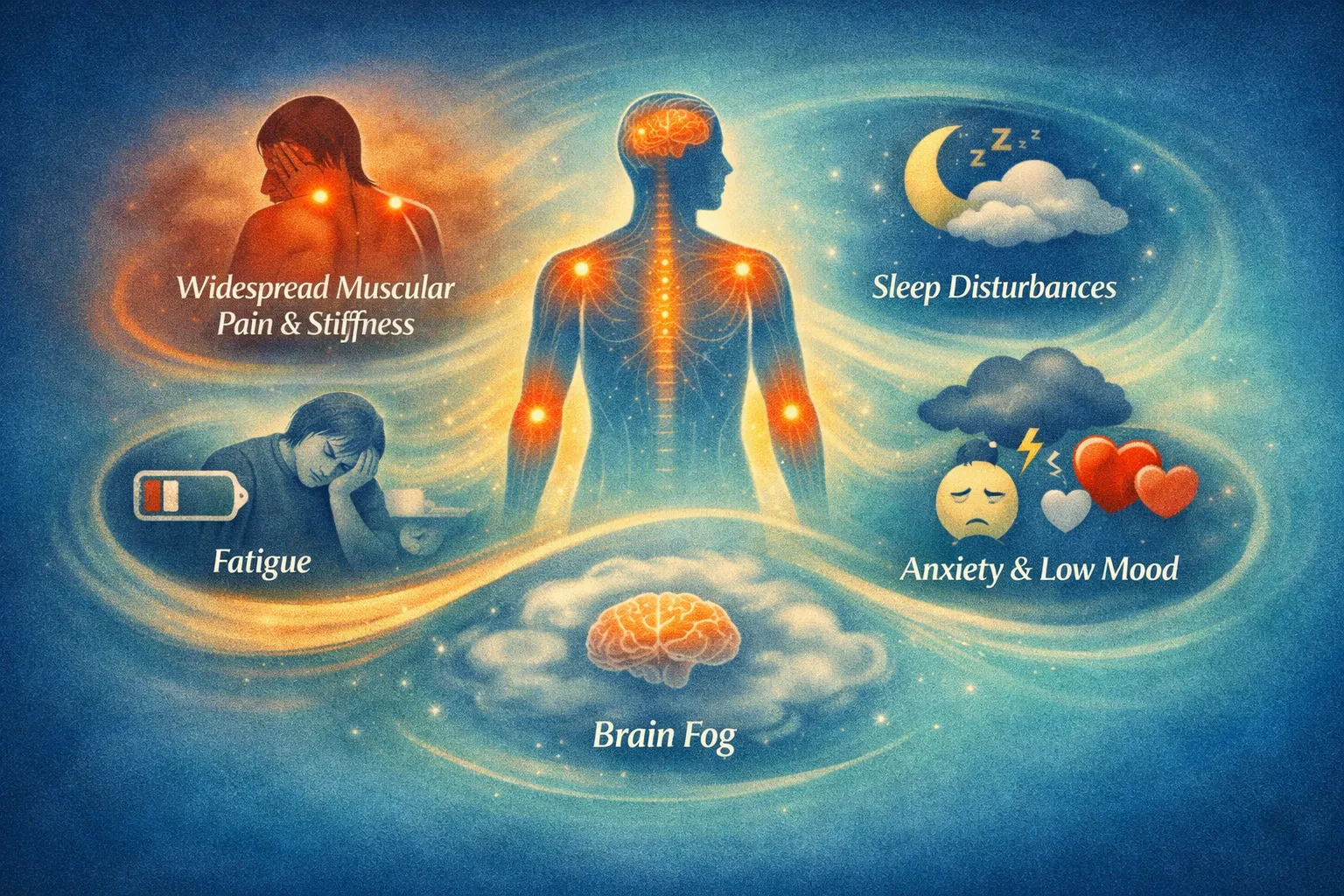
Fibromyalgia is a medical diagnostic term given to someone suffering with a combination of persistent symptoms of:
- widespread muscular pain and stiffness
- fatigue
- sleep disturbances
- anxiety and low mood brain fog
These symptoms often fluctuate and can be very disabling and negatively affect all areas of life. There is currently no specific medical test which identifies fibromyalgia, but normal blood tests results rule out the presence of a recognised disease process.
Fibromyalgia has historically been misunderstood when viewed through a limited biomedical lens. As a result, it offers treatment to manage and learn to live with symptoms using medication, physical therapies, and psychological approaches. Symptomatic treatment does offer some benefit, but it is not satisfactory for the millions of people worldwide who have received this diagnosis and are understandably desperate for a better understanding and solutions for their suffering.
The good news is that advances in neuroscience research is offering clearer explanations beyond the symptoms to the complex mind-body interaction and the root causes in the central nervous system driving them— and this offers more hope for the possibility of recovery. (see the link to recovery stories below)
Fibromyalgia is considered to be a complex, multifactorial condition involving central sensitisation, nervous system dysregulation, and possible immune contributions. And yet, Fibromyalgia is increasingly becoming recognised as a neuroplastic condition, which is good news.
N.B. Neuro refers to the involvement of the nervous system, and plastic, because learned neural pathways can be unlearned and healthier responses rewired.

A neuroplastic diagnosis offers a scientific explanation for how real symptoms in the body and mind can occur in the absence of tissue damage or disease. It recognises how symptoms can be the result of a nervous and immune system stuck in chronic survival physiology in response to overwhelming unresolved past and current life stress and trauma.
These normal systems of our mind and body have a protective purpose. However, in Fibromyalgia, similar to many other chronic pain conditions, the response has become conditioned and sensitised, meaning that very real symptoms can be caused by normal safe movement, emotional and sensory inputs.
It can be helpful to start to see this link, by pausing and becoming curious to consider what build up or overwhelming stressors occurred in your life, at work, home and personally, at the time of onset of your symptoms, and to also notice how your symptoms may fluctuate in response to different life experiences.
Analogy: It is like having a car which the mechanic checks out as having no mechanical problems to explain the strange burning smell. But the mechanic doesn’t see how you drive your car, burning it out with your foot flat on the accelerator it as if you are being chased or going around in circles with the accelerator and brake on at the same time. The solution is to learn how to ‘drive the car’ calmly and smoothly, being able to accelerate or brake appropriately, instead of being stuck in fear mode of driving, so to speak!
Fibromyalgia symptoms are real and are not ‘in your head’— but this new science demonstrates that symptoms can occur for reasons other than due to damage or disease in the body. And when these root causes are identified and addressed, the symptoms can be resolved. Recovery has already been experienced by many people suffering with Fibromyalgia who were ready to consider a different explanation, and who were ready to actively engage and be supported in a completely different and more integrated treatment approach.
What does the up to date science show?
1. Central Nervous System Sensitisation
The brain and spinal cord become more sensitive and reactive, amplifying signals that would not normally be painful. This is often referred to as central sensitisation.
2. Immune System Involvement
Emerging research, including studies from King’s College London, suggests that immune activity may play a role in increasing nerve sensitivity. This reflects an interaction between the immune system, nervous system, and stress response.
3. Chronic Stress Physiology
The body can become stuck in a prolonged “threat” or survival state (fight-or-flight), driven by:
- Ongoing stress
- Emotional overload
- Past experiences or trauma
- Internal pressure (e.g. perfectionism, people-pleasing)
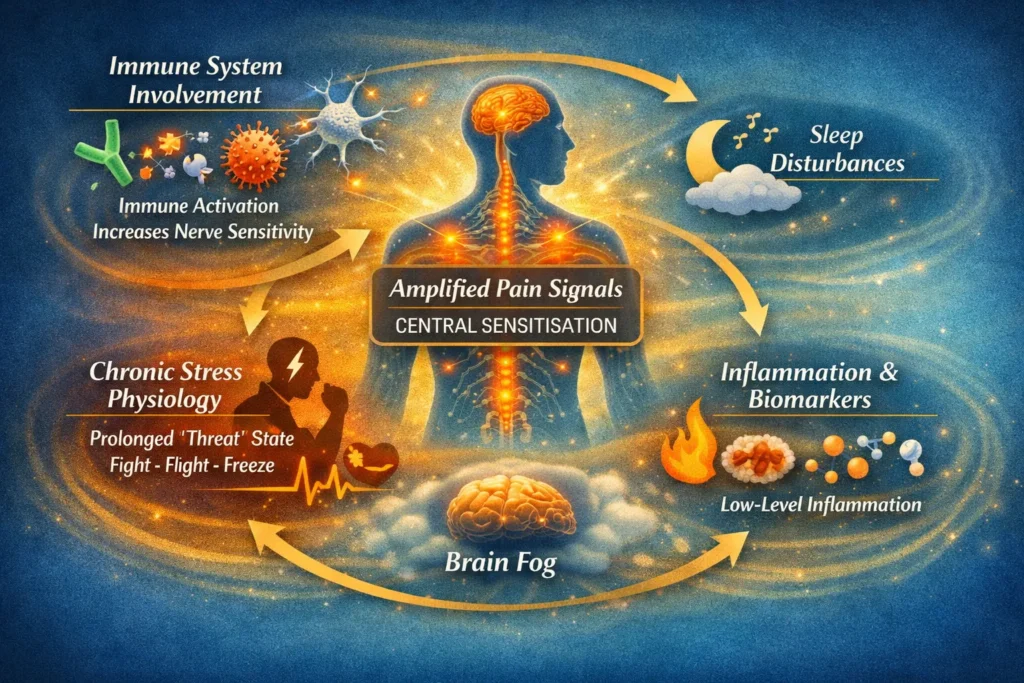
This state can trigger both nervous system sensitisation and immune responses such as fatigue and widespread pain.
4. Inflammation & Biomarkers
Low-level (micro) inflammation may be present, but is now understood more as a marker of chronic stress physiology rather than a primary cause of symptom
Modern pain science:
The revolution in pain science research has proven that all pain is experienced in the body, but is a response created by the brain when it perceives threat. Potential threat inputs include:
- Stress
- Past experiences
- Emotional overload
- Fearful beliefs about damage in the body
- Nervous system sensitivity
This does not mean symptoms are imagined. It means the brain and body are working together in ways that can be influenced — and supported — through the right approaches.
This is the foundation of the SIRPA approach.
Why Pain Persists
Pain can continue even when no physical injury is present because:
- The nervous system becomes sensitised
- The brain learns to associate certain movements or situations with danger
- Stress and emotional strain remain high
- Stress and immune activity may amplify pain signals
- The body stays in a protective state
These patterns can become “wired in,” but — crucially — they can also be rewired.
What science is now saying…
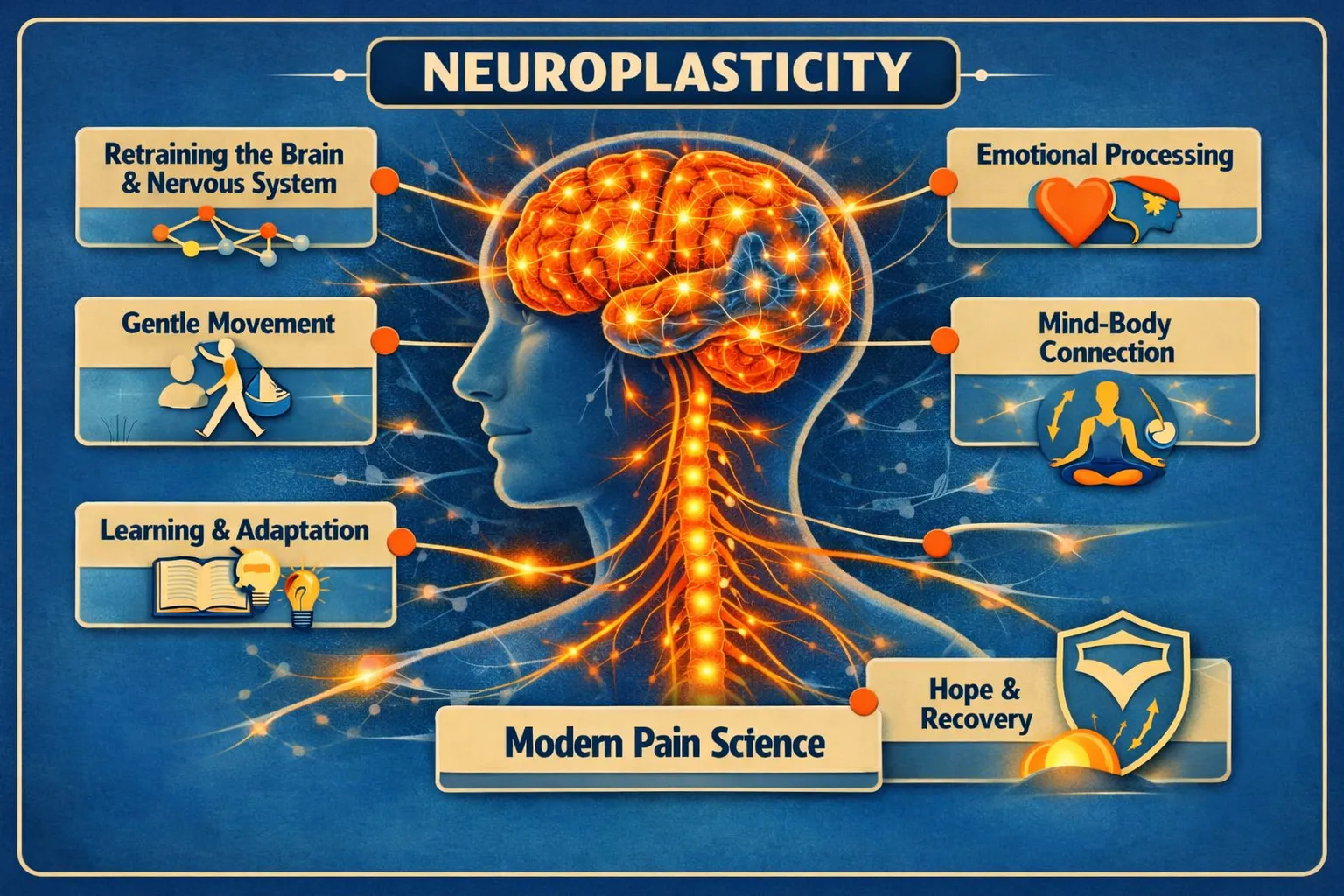
A multidimensional approach is most effective in the treatment of Fibromyalgia. Research supports:
- Pain education
- Nervous system regulation
- Retraining the brain and nervous system (neuroplasticity)
- Emotional processing
- Gentle enjoyable movement
- Psychological therapies
- Medication (where appropriate)
- Immune‑informed approaches (emerging)
How the SIRPA Approach Supports Recovery
SIRPA (Stress Illness Recovery Practitioners Association) is grounded in modern pain science and focuses on neuroplastic recovery — helping the nervous system shift from protection to safety in a cohesive, person-centred framework.
Rather than focusing only on symptoms, SIRPA addresses the root causes of perceived danger in the mind-body system.
Key Elements of the Approach
There is no silver bullet. Instead, consistently applied safety strategies rewire the mind-body system back to health and wellbeing. This may include:
- Educating with up to date science to reduce perceived danger by challenging fearful beliefs and misunderstandings about symptoms and the ability to recover.
- Instructing nervous system safety and regulation strategies to restore the body to safety states of relaxation and recovery
- Instructing somatic techniques to improve awareness and calm connection to the felt sense of the body, including connection to pleasant sensations to increase safety messages to the brain.
- Learning safe emotional awareness and processing helps people experience emotions without fear or guilt. This teaches the brain that feelings such as anger and grief are not shameful or dangerous, reducing the physiological danger response that can contribute to pain.
- Identifying and resolving sources of overwhelming emotional stress from childhood, current life stress, and internal stress from adaptive personality traits such as perfectionism, people pleasing, goodism, over-responsibility, and being very driven.
- Learning how to respond to symptoms with curiosity and calm to rewire safety pathways in the brain, in place of the reflex fight and flight response which perpetuates the fear-pain cycle

- Supporting return to enjoyable movement and activities using perceived threat reappraisal and graded exposure through a lens of safety, accurate knowledge and corrective experiences.
- Developing a kinder internal dialogue and connection to self, thus reducing danger messages by learning how to reduce excessive pressure and self-criticism and replace with kindness, patience and self-compassion.
- Becoming more self-empowered: reconnecting to values and feeling safe to speak up and communicate needs and put in boundaries to prioritise more time for pursuing individual pleasures and ensure better self-care.
- Referral to a trauma therapist if history of trauma has been identified
SIRPA Practitioners can make a meaningful and significant difference for people suffering with symptoms of Fibromyalgia. They provide a whole person, individualised mind-body approach. Treatment strategies use the scientific principles of neuroplasticity to resolve the root causes of perceived danger driving the over-protective defensive mechanisms creating symptoms.
Can Recovery Happen?
Yes — many people experience significant improvement, and many also recover fully. There are testimonials and Success stories available. Here are a few for you to watch. These stories indicate that reversing Fibromyalgia is possible when the brain can learn it is safe to relax the over-protective responses and how to become more self-empowered.
Key Fibromyalgia Success Stories & Themes:
- Pippa Cossens Osteopath who suffered from severe Fibromyalgia to the point where walking her dog was difficult. Using the SIRPA approach, she fully recovered and went on to climb the 3 UK Peaks.
- Adam (Fibromyalgia/Small Fibre Neuropathy): Overcame a state of being bedridden and unable to work to living a pain-free life, now running his own business.
- Carole (Fibromyalgia/CFS): Shifted her focus from fear of pain to understanding her emotional triggers, achieving full recovery and placing her health at the heart of her decisions.
- Sara Varo: Recovered from debilitating chronic symptoms, including Central Sensitivity Syndrome, and now works as a SIRPA coach to help others see recovery as achievable.
- Debbie: Experienced a near-total disappearance of pain within two weeks of starting the program, using visualization and journaling to process emotions.
- Listen to Unravelling The Mystery of Fibromyalgia podcast by Dr Howard Schubiner.
In brief, recovery often involves:
- Reducing fear around symptoms
- Understanding pain science
- Addressing emotional stressors
- Supporting the nervous system to feel safer
- Retraining the brain and nervous system through a lens of safety
- Support into how to re‑engage with meaningful activities and movement
- Building confidence in the body again
- Developing self-compassion, and
- Prioritising time for self-care and personal interests
Recovery doesn’t always mean symptoms disappear entirely, but it does mean regaining control, reducing distress, and returning to the life you want to live.
Final Thoughts
Fibromyalgia is real, complex, and deeply human. But the science is moving forward — and with it, new understanding and new hope.
The SIRPA approach offers a compassionate, evidence‑aligned pathway that helps people make sense of their symptoms and supports the nervous system in moving toward safety, connection, and recovery.
If you’re currently living with Fibromyalgia, remember:
- Your symptoms are real
- Your body is not broken or damaged but may be deconditioned due to symptoms limiting activity.
- There is new science
- You are not alone
- Your nervous system can change
- Recovery is possible
And you deserve support that sees the whole of you — not just your symptoms.
Authors
This article was written by SIRPA Practitioners and SIRPA Board Members, Irralee Andrzejowska and Carole Randell
Bibliography
- Arnold, L.M., Bennett, R.M., Crofford, L.J., Dean, L.E., Clauw, D.J., Goldenberg, D.L., Fitzcharles, M.-A., Paiva, E.S., Staud, R., Sarzi-Puttini, P. and Buskila, D. (2019) ‘AAPT Diagnostic Criteria for Fibromyalgia’, The Journal of Pain, 20(6), pp. 611–628.
- Clauw, D.J. (2014) ‘Fibromyalgia: A clinical review’, Journal of the American Medical Association (JAMA), 311(15), pp. 1547–1555.
- Goebel, A., Krock, E., Gentry, C., Israel, M.R., Jurczak, A., Urbina, C.M., Sandor, K., Vastani, N., Maurer, M., Cuhadar, U. and others (2021) ‘Passive transfer of fibromyalgia symptoms from patients to mice’, Journal of Clinical Investigation, 131(13), e144201.
- King’s College London (2021) New study shows fibromyalgia likely the result of autoimmune problems. Available at: https://www.kcl.ac.uk/news/new-study-shows-fibromyalgia-likely-the-result-of-autoimmune-problems
- King’s College London (2025) Immune system changes affecting sensory nerves could cause fibromyalgia. Available at: https://www.kcl.ac.uk/news/immune-system-changes-affecting-sensory-nerves-could-cause-fibromyalgia
- Lumley, M.A., Schubiner, H., Lockhart, N.A., Kidwell, K.M., Harte, S.E., Clauw, D.J. and Williams, D.A. (2017) ‘Emotional awareness and expression therapy, cognitive behavioral therapy, and education for fibromyalgia: A cluster-randomized controlled trial’, PAIN, 158(12), pp. 2354–2363.
- McEwen, B.S. (2007) ‘Physiology and neurobiology of stress and adaptation: Central role of the brain’, Physiological Reviews, 87(3), pp. 873–904.
- Melzack, R. and Wall, P.D. (1965) ‘Pain mechanisms: A new theory’, Science, 150(3699), pp. 971–979.
- Moseley, G.L. (2007) ‘Reconceptualising pain according to modern pain science’, Physical Therapy Reviews, 12(3), pp. 169–178.
- National Institute for Health and Care Excellence (NICE) (2021) Chronic pain (primary and secondary) in over 16s: Assessment of all chronic pain and management of chronic primary pain (NG193). London: NICE.
- Onuora, S. (2021) ‘Antibodies induce fibromyalgia symptoms’, Nature Reviews Rheumatology, 17, p. 455.
- van der Kolk, B.A. (2014) The Body Keeps the Score: Brain, Mind, and Body in the Healing of Trauma. New York: Viking.
- Woolf, C.J. (2011) ‘Central sensitization: Implications for the diagnosis and treatment of pain’, Pain, 152(3 Suppl), pp. S2–S15.