
5 minutes
⟵ Back to Blog
Understanding the Many Faces of Stress
Contents
It started with a question I wasn’t open to hear.
‘What is going on in your life at the moment?’
I remember how irritated that made me feel. Here I was, sitting in a doctor’s office with a body full of symptoms I couldn’t explain, and he was asking about stress. I wanted answers. I wanted a diagnosis, a pill, a plan. Something tangible.
‘Nothing out of the normal,’ I replied.
‘How is your relationship?’
My irritation sharpened. In my mind, he was looking in completely the wrong direction.
‘Great’
He sensed my frustration but pressed on. ‘Work? Financial stress?’
“ALL FINE”, I wanted to prove to him his investigation was taking him up the wrong stream.
Ten years on, I can reflect with a clarity I didn’t have in that room.
It was stress related, but the word ‘stress’ was not resonating.
If he had leaned forward and asked, ‘How worried are you about what’s happening in your body?’ — I would have replied TERRIFIED! The fear of my symptoms was its own storm. It was the stress that had been fuelled by catastrophising, and it created an escalation of a multitude of ‘unexplained’ symptoms.
So, this is where I want to begin: with the word stress itself, and why it deserves a much wider, more honest conversation.
Consider this…
Stress is the body’s response to a perceived challenge, threat, or demand. That one word — perceived — is everything. The body does not require a ‘real’ threat to activate a stress response. It only needs to believe one is present.
That is why two people can face the same situation and experience it entirely differently. One person’s excitement is another person’s terror. The nervous system is not responding to facts; it is responding to meaning.
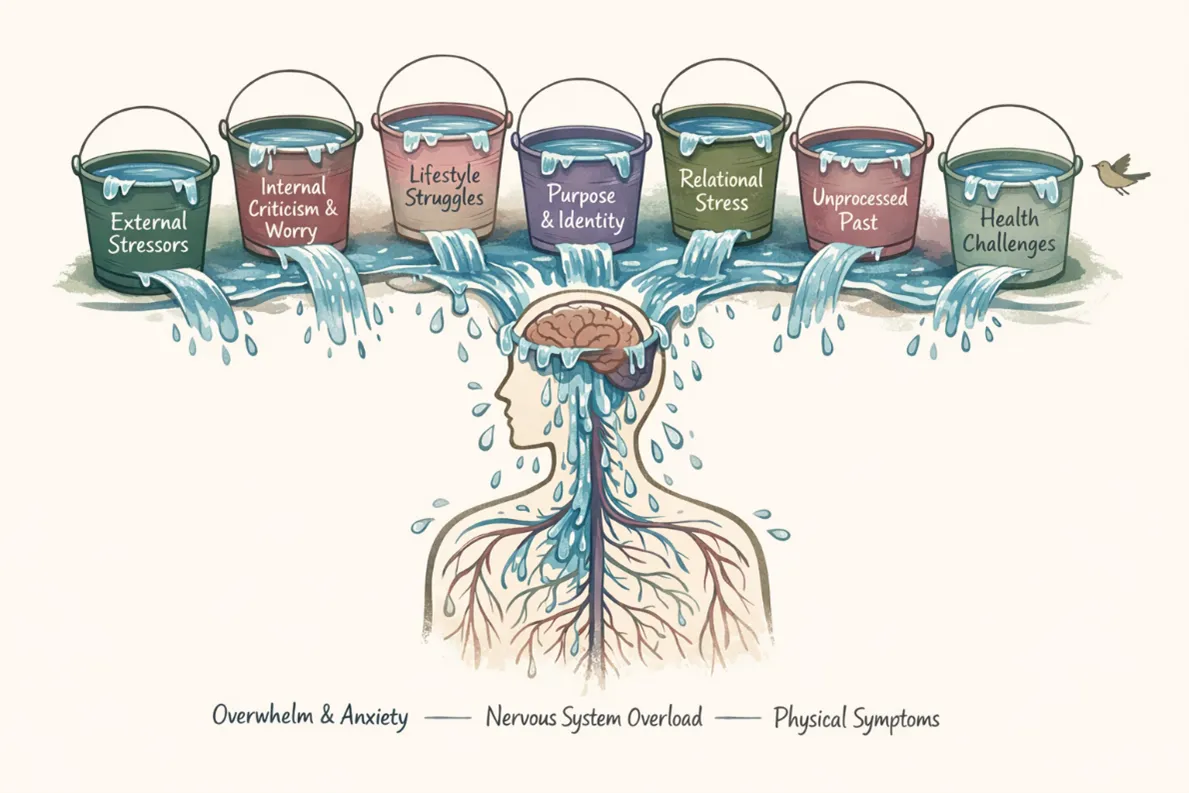
With that in mind, let me walk you through the many buckets of stress because the one the doctor pointed towards was not connecting with me, but it is only one of many forms and flavours of stress.
The Stress Buckets
Are any of the following stress buckets overflowing?

1. External Life Stressors
The ones my doctor was reaching for, job pressure, relationship difficulties, financial strain, bereavement, moving home, a difficult diagnosis. These are visible, nameable stressors.
For me, this bucket was genuinely quite empty. My answers were a confident no. And yet I was unwell.
2. Internal – Mental & Emotional Stressors
This is the category that explained so much of my experience.
Internal stressors live inside the mind. They include:
Inner criticism: the relentless voice that tells you you’re not enough, that you’re failing, that something is fundamentally wrong with you.
Chronic worry: a mind that is always scanning for what could go wrong, running catastrophic simulations in the background.
Deep shame or guilt: the weight of things left unsaid, unresolved, or unforgiven carried quietly for years.
Fear of symptoms: when the body produces unexplained sensations, fear becomes its own stressor, amplifying the very thing you are afraid of.
From the outside, everything looked fine. And it was. But inside, the nervous system was in a constant threat response. You don’t need an external storm to drown, sometimes the weather is entirely internal.
3. Lifestyle Stressors
We often underestimate how profoundly our daily habits signal safety or danger to the body.
This bucket includes: ultra-processed foods that dysregulate blood sugar and inflammation; chronic sleep deprivation; over-exercising without adequate recovery; under-moving for long periods; alcohol and caffeine that disrupt the nervous system; and the accumulated weight of screens, noise, and overstimulation.
None of these feel like ‘stress’ in the traditional sense. But to the body, a blood sugar crash, a cortisol spike from poor sleep, or a gut inflamed by processed food is a genuine physiological threat.
4. Purpose & Identity Stressors
This one is perhaps the most quietly corrosive and the least talked about.
When the life you are living is not aligned with who you are, your values, your ethics, your sense of meaning, your nervous system knows. Something in you is always slightly braced, slightly suppressed, slightly performing.
This might look like staying in a career that pays well but costs you something essential. It might be remaining in a role, a relationship, or an identity that no longer fits. The body keeps the score not just of trauma, but of inauthenticity.
5. Relational & Social Stressors
Humans are wired for connection. When our relational world feels unsafe through loneliness, social isolation, conflict, or the exhausting effort of masking who we are the nervous system responds accordingly.
This includes not just overtly difficult relationships, but subtle dynamics: feeling chronically unseen, caring for others at the expense of self, people-pleasing to the point of self-erasure, or simply spending years in environments where you cannot be yourself.
6. Unprocessed Past Stressors
The nervous system does not distinguish clearly between past and present. A memory, a pattern, a body sensation that was learned in an early experience of threat can be re-activated in the present often without us realising it.
Unresolved grief, childhood experiences of unpredictability or criticism, moments of helplessness that were never fully processed these can live in the body long after the original event has ended. The stress is not current; but the body’s response to it is.
7. Physiological & Health Stressors
Chronic illness, hormonal imbalances, menopause, gut dysbiosis, nutritional deficiencies, and pain itself are all stressors on the body. When the system is already carrying any of the above stress load, its threshold drops significantly. I developed chronic food sensitivities, but these were a symptom of my overloaded nervous system.
A New Understanding

When I left that doctor’s appointment, I left believing stress had nothing to do with what was happening to me.
When I look back now, the doctor was right about stress, just exploring the wrong tributary.
Stress is not always the big, visible, external pressures of modern life. It is the accumulation of everything the nervous system has been asked to carry seen and unseen, past and present, inner and outer.
Understanding your own stress buckets is not about blame or explanation. It is about curiosity. It is asking: what has my body been holding?
Are you ready to move upstream and address the source?