
5 minutes
⟵ Back to Blog
Chronic Illness Recovery Day – 13th July 2026
Contents
Rooted in Hope, Growing Towards Recovery
Chronic Illness Recovery Day is a moment to pause, honour our stories, and recognise the courage it takes to heal. For me, this day carries deep personal meaning. My own journey through CFS/M.E. and fibromyalgia taught me something life‑changing: these conditions are not degenerative diseases, but treatable neuroplastic conditions. They reflect a nervous system stuck in protection mode — not a body that is failing.
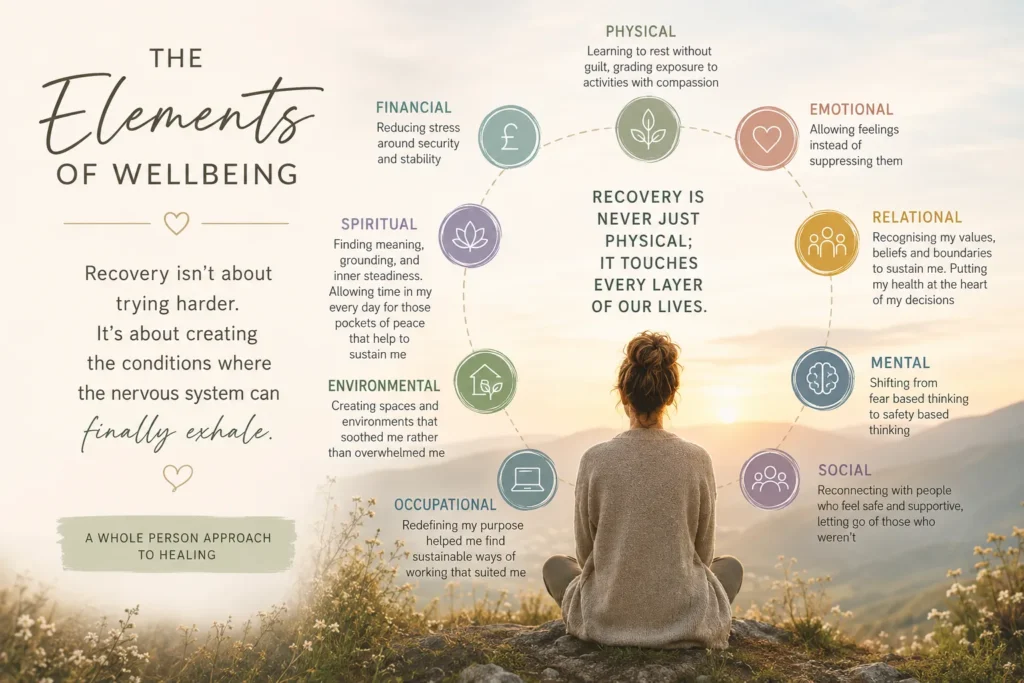
That understanding changed everything. It helped me stop fighting myself and start listening to what my symptoms were trying to protect me from. As I began to explore all the elements of wellbeing — not just the physical — I discovered the power of a Whole‑Person Approach to Healing. Recovery, I realised, is never just physical; it touches every layer of our lives.
These Elements of Wellbeing became the framework that helped me rebuild safety, connection, and trust in my body:
- Physical — learning to rest without guilt, grading exposure to activities with compassion
- Emotional — allowing feelings instead of suppressing them
- Relational — recognising that my values, beliefs, and boundaries were there to sustain me, and allowing my authentic self to emerge without apology. Putting my health at the heart of my decision making
- Mental — shifting from fear‑based thinking to safety‑based thinking
- Social — reconnecting with people who felt safe and supportive, letting go of those who weren’t
- Spiritual — finding meaning, grounding, and inner steadiness, allowing time in my every day for those pockets of peace that help to sustain me
- Environmental — creating spaces and environments that soothed me rather than overwhelmed me
- Occupational — redefining my purpose helped me find sustainable ways of working that suited me.
- Financial — reducing stress around security and stability
These elements helped me understand that recovery isn’t about “trying harder”. It’s about creating the conditions where the nervous system can finally exhale.
How Personality, ACEs, and Triggers Shape Chronic Pain and Fatigue
Many people living with chronic pain or chronic fatigue share similar patterns: being the strong one, the responsible one, the quiet one and/or the one who copes no matter what. Research shows these traits often begin in childhood, especially for those who grew up with Adverse Childhood Experiences (ACEs) or in environments where being careful, invisible, compliant, or hyper‑responsible helped us stay safe (Felitti et al., 1998; Anda et al., 2006).
That was certainly true for me. I grew up this way, and my nervous system adapted. I learned to stay on high alert — scanning for danger, managing everything, and never letting my guard down — a pattern strongly linked to long‑term stress‑response activation (Heim et al., 2009; McEwen, 1998).
We now have research showing that long‑term vigilance, chronic stress, and emotional overload can overwhelm the body’s protective systems, contributing to both chronic pain and CFS/M.E. symptoms. Chronic stress can dysregulate the HPA axis (Nater et al., 2008; Tak et al., 2011), increase autonomic imbalance and hypervigilance (Kempke et al., 2010; Van Houdenhove et al., 2001), and drive neuroplastic changes such as central sensitisation and heightened pain processing (Woolf, 2011; Moseley & Butler, 2015). These shifts — involving neuroinflammation, altered cortisol rhythms, and changes in brain networks — can all contribute to persistent pain and fatigue.
Understanding this isn’t about blame — it’s about compassion.
Despite the science, this is still a deeply personal experience. It’s about recognising that your symptoms make sense. And when triggers or activations happen now — a tone of voice, a crowded room, a sense of not being good enough — they’re not signs of failure. They’re echoes of old patterns that can be rewired.
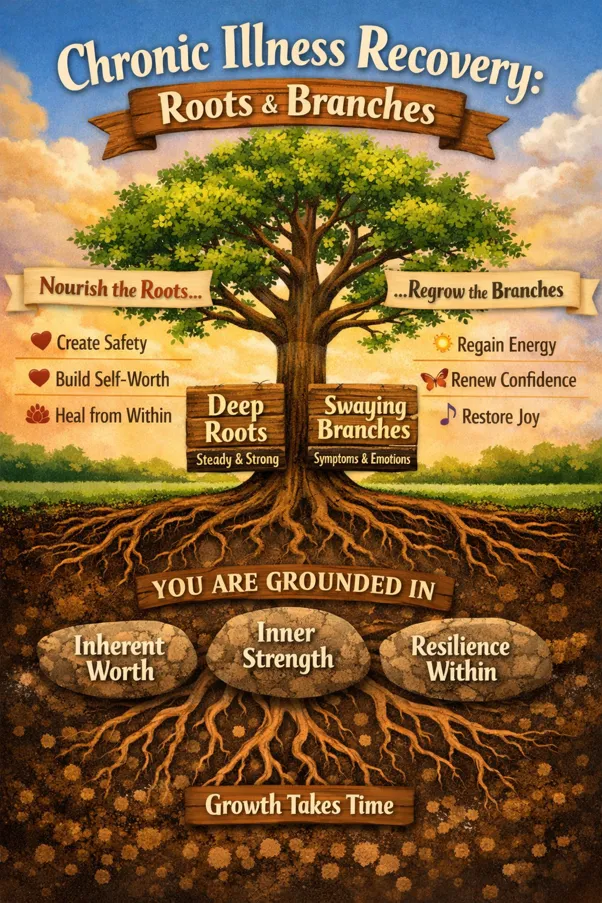
A Metaphor for Recovery — Roots and Branches
I often think of recovery like a tree.
Your roots are your self‑worth, your inherent value, your nervous system’s capacity for safety.
Your branches are your symptoms, your confidence, your energy levels — the parts of you that sway with stress, seasons, and life.
When chronic illness hits, it can feel like the branches are bare, fragile, or breaking.
But the roots?
They are still there.
Deep. Steady. Waiting.
Recovery is not about forcing the branches to grow.
It’s about nourishing the roots so the branches can return in their own time.
The Support That Made Recovery Possible
I wouldn’t be where I am without the outstanding support I received through SIRPA.
SIRPA gave me:
- a science‑based understanding of neuroplastic symptoms
- a compassionate, trauma‑informed framework
- a community that truly “gets it”
- and the confidence to trust my own lived experience
It was the final piece of the jigsaw in my recovery — the part that helped everything click into place. And the best bit; I didn’t have to explain anything, they just knew.
One Step You Can Take Today
Recovery doesn’t happen in leaps. It happens in small, nervous‑system‑safe steps.
So, here’s a gentle question for today:
What is one step you could take that nourishes your roots?
Here are a few examples:
- A grounding breath when you notice symptoms rising
- Saying “I matter even when I feel unsure” to soften self‑criticism
- Taking a 5‑minute rest without earning it
- Noticing one moment of safety in your day
- Letting yourself feel one emotion instead of pushing it down
- Choosing connection — sending a message to someone who feels safe
- Doing something tiny that brings joy — a warm drink, a quiet moment, a walk outside
Small steps are not insignificant.
They are the beginning of new neural pathways.
A Message of Hope
Recovery is possible.
Not because you need to be stronger, or braver, or better —
but because your nervous system is capable of change. You deserve this.
Forget those old beliefs that you inherited,
You are not broken.
Your symptoms are not a life sentence.
Your roots are still there.
And with the right support, compassion, and understanding, you can grow again.