
8 minutes
⟵ Back to Blog
Hypermobility from a Mind Body perspective
Contents
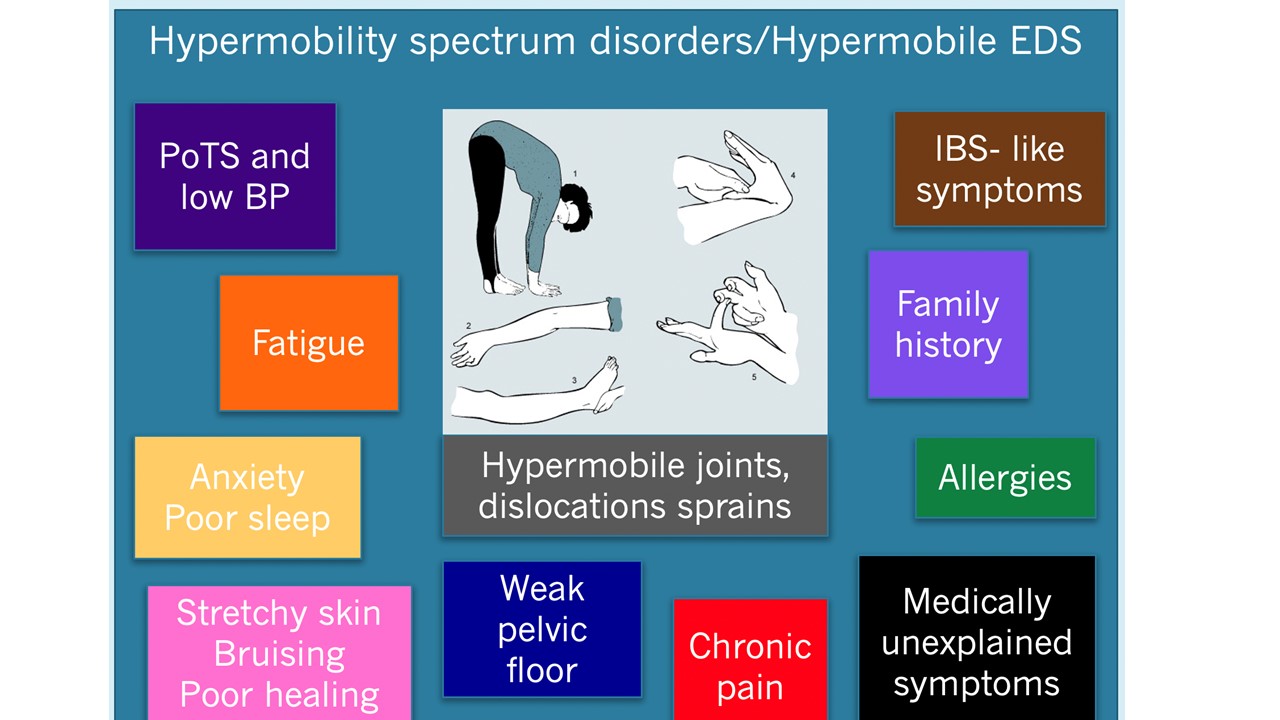
The term joint hypermobility (also known as being “double-jointed”) describes the ability to move a joint through a wider range of movement than “normal”. Associated symptoms may include joint and muscle pain, joint dislocations, temporomandibular joint (TMJ) dysfunction, fast heart rate, low blood pressure, dizziness, fainting, irritable bowel, gastroparesis (where the food moves slowly though the gut), pelvic pain, headaches, interstitial cystitis, fatigue, prone to allergies, anxiety and other mental health issues (1).
It is interesting to note that all these symptoms are common in PPD/TMS.
In 2017, the terms Hypermobility Spectrum Disorder (HSD) and Hypermobile Ehlers Danlos Syndrome (hEDS) have replaced the following terms previously used (2):
- Joint hypermobility syndrome
- Benign joint hypermobility syndrome
- Ehlers-Danlos (hypermobility type)
- Ehlers-Danlos type III
Generalised hypermobility is diagnoses using the Beighton score. https://www.potsuk.org/hypermobility_and_pots
To have a diagnosis of hEDS, there needs to be a positive Beighton score and a complex criteria met. Anyone else is given a diagnosis of HSD when there is generalised hypermobility with other associated symptoms.
It is believed that hEDS is a genetic connective tissue disorder, one of 13 sub types of EDS, though NO gene has been identified for this sub type. Even if there was a gene, when we consider epigenetics, we might ask what is causing the gene to be switched on if symptoms begin? Bruce Lipton would suggest 98% of our illnesses are due to our environment, with only 2% actually being due to our genes (3).
See here for further information on EDS classification. https://www.ehlers-danlos.com/ehlers-danlos-info/
Observations as a Pilates teacher
As a Pilates teacher, I have observed hundreds of clients and teachers move and many are VERY hypermobile, yet they have NO other health issues. Some are just naturally more mobile, because that’s the way they are, whereas others have been involved in dance or gymnastics from a young age, which has led to a developmental hypermobility.
I have worked with clients with multiple additional symptoms, which have been put down to hypermobility, yet when I watch them move they are often no more mobile that many of my other clients.
There does not seem to be a clear correlation between hypermobility and symptoms. So why the symptoms? Is there really a connective tissue disorder causing hypermobility? Is hypermobility being used to give an explanation for the multiple unexplained medical symptoms a person may present with, distracting one from dealing with the underlying cause? Have we medicalised something that is a normal variant?
I have no doubt that there could well be a connective tissue disorder causing the symptoms in some people. However, I would suggest this is the minority of sufferers.
Diagnostic criteria and EDS
“What is it with hypermobility in the UK” I was asked at an international conference on Breathing Pattern Disorders and Long-COVID. The physiotherapists in attendance had become increasingly aware that there seems to be an epidemic of hypermobility in the UK.
My observation has been that if someone has symptoms of palpitations, dizziness and feeling faint, they may end up in a Cardiology clinic where they are asked to undertake the Beighton score and then often a diagnosis of hypermobility is made. I even had a client who was told they had “stiff hypermobility”, to justify his symptoms of fatigue and pain!
The patient is often delighted that all their symptoms can now be explained and this soon gets translated by the patient as “I have EDS”. Now they have a fancy diagnostic label (that I can neither say nor spell) to cling on to, which becomes their identify. Many people who previously were given a diagnosis of EDS based on the older criteria, will hold onto it, even though they may no longer meet the complex criteria for hEDS.
Pain
90% of people diagnosed with hypermobility experience chronic pain (4) and many are then diagnosed with Fibromyalgia. The pain often starts with an acute injury such as a ligament sprain, or joint dislocation, but this does not account for ongoing pain one may experience, with neural circuit pain being the likely cause.
Mast Cell Activation Syndrome (MCAS) and Postural Tachycardia Syndrome (PoTS)
MCAS and PoTS may coexist with HSD and hEDS (5).
PoTS is common in those with HSD/hEDS, with 50% being hypermobile (6), though some centres would say it is much higher than this. Symptoms include tachycardia (fast heart rate) on being upright, fatigue, and dizziness. Breathing pattern disorders are also common in PoTS, with 80-90% having Hyperventilation syndrome (breathing in access of metabolic demand) (7).
PoTS is known to be due to a dysfunction of the Autonomic Nervous System (ANS), but no clearer mechanism for the symptoms have been found by the scientific community.
But why the ANS dysfunction and why the breathing pattern disorder?
Mast Cell Activation Syndrome (MCAS)
MCAS is a dysfunction of the Mast cells which are a normal part of our body’s immune system and help to fight infection. These cells are involved in allergic and inflammatory reactions. When they are activated they release many chemicals, such as histamine and cytokines. When there is dysfunction of the Mast Cells many vague symptoms may occur, such as – skin flushing, urticaria, allergic rhinitis, wheezing, breathlessness, fatigue, pain, syncope, rapid heart rate, low blood pressure, diarrhoea, abdominal cramps, nausea and many other symptoms. For some, the allergic reactions can be severe. Symptoms may be triggered by an external stimulus such as food, medication, exercise, stress, to name a few. But why is the body responding in this way?
https://www.mastcellaction.org/mcas-symptoms
The link between MCAS, hEDS and PoTS
MCAS, PoTS and HSD/hEDS often occur in the same individual, but a common pathophysiological mechanism between any of the two has yet to be described. All three conditions remain controversial in either existence or understanding of the mechanism, and there is a lack of scientific evidence of the existence of MCAS, or hEDS as a separate or significant clinical entities (8).
Dysregulation of the autonomic nervous system and the immune system
The ANS can be divided into the parasympathetic nervous system (PNS) which is involved in rest, digest and restore and the sympathetic nervous (SNS) system being our fight or flight, or even freeze response, which is activated where there is a perceived threat.
When the perceived threat is constant, the SNS become overactive, releasing cortisol and adrenaline, our stress hormones. It’s not surprising this results in a fast heart rate, respiratory rate, dizziness, excess sweating and many other symptoms of PoTS.
The immune system is closely linked with the ANS and when the body is stressed the immune system is suppressed, making one more susceptible to infections. This causes the body to become more responsive to external stimuli, creating the symptoms of MCAS.
Stress and Trauma
Literature has identified a high prevalence of anxiety, depression, addictions, eating disorders, attention deficit disorder and autism in those with HSD/hEDS (9). Another study found a greater perception and intensity of fear and a higher probability of agoraphobia, anxiety, depression and panic disorder in those who were diagnosed with joint hypermobility syndrome (10).
Observing on social media, many talk about struggling with anxiety, PTDS or symptoms starting after a traumatic event.
I have spoken to, and worked with, many who have a diagnosis of PoTS, HSD/hEDS ,ME and Long Covid and nearly always find that individuals are dealing with stress, trauma (past or current) and suppressed emotions. One client told me, “I feel like I am running on adrenaline”. Many acknowledge being a perfectionist, people pleaser, driven, conscientious, self-critical, and many other TMS personality traits and a high level of childhood anxiety is common.
No wonder these patients are on sympathetic over drive, have hyperventilation syndrome and an immune system that is sensitive to external triggers all creating symptoms.
We know that chronic stress causes physiological changes in the body. SYMPTOMS ARE REAL, THEY ARE NOT JUST IN YOUR HEAD!!
The mind and body are connected, but no one is making the connection!
The good news
There is so much hope.
I truly believe we can help, and I fact I have seen the benefit of a mind body approach, working with this client group.
References
- Tinkle, B. et al (2017). Hypermobile ehlers-danlos syndrome (a.K.A. Ehlers-danlos syndrome type iii and ehlers-danlos syndrome hypermobility type): Clinical description and natural history. Am J Med Genet C Semin Med Genet. doi: 10.1002/ajmg.c.31538
- CastoriM, Tinkle B, Levy H, Grahame R, Malfait F, Hakim A. (2017). A framework for the classification of joint hypermobility and related conditions. Am J Med Genet Part C Semin Med Genet 9999C:1–10.
- Lipton, B (2015)The Biology of Belief: Unleashing The Power Of Consciousness, Matter & Miracles: Unleashing the Power of Consciousness. Hay House
- Chopra P, Tinkle B, Hamonet C, Brock I, Gompel A, Bulbena A, Francomano C. (2017). Pain management in the Ehlers–Danlos syndromes. Am J Med Genet Part C Semin Med Genet 9999C:1–8.
- Raj S.R et al (2020) Society Position Statement: Canadian Cardiovascular Society Position Statement on Postural Orthostatic Tachycardia Syndrome (POTS) and Related Disorders of Chronic Orthostatic Intolerance. Canadian Journal of Cardiology,36, 357e372
- Celletti C. Borsellino B.Castori Cens F. Calcagnini G, Camerota F. Strano S. (2020)A new insight on postural tachycardia syndrome in 102 adults with hypermobile Ehlers-Danlos Syndrome/hypermobility spectrum disorder. Mo naldi Archives for Chest Disease; volume 90:1286
- ReillyaC. et al (2020) Breathlessness and dysfunctional breathing in patients with postural orthostatic tachycardia syndrome (POTS): The impact of a physiotherapy intervention. Autonomic Neuroscience: Basic and Clinical 223
- Kohn, A and Chang C (2020) The Relationship Between Hypermobile Ehlers-Danlos Syndrome (hEDS), Postural Orthostatic Tachycardia Syndrome (POTS), and Mast Cell Activation Syndrome (MCAS). Clinical reviews in allergy & immunology; Jun 2020; vol. 58 (no. 3); p. 273-297
- Bulbena et al (2017) Psychiatric and Psychological Aspects in the Ehlers–Danlos Syndromes ThereAmerican Journal of Medical Genetics Part C (Seminars in Medical Genetics) 175C:237–245 (2017)
- Toby O. Smith et al (2014) The relationship between benign joint hypermobility syndrome and psychological distress: a systematic review and meta-analysis. Rheumatology, Volume 53, Issue 1, January 2014, Pages 114–122